Honda’s hybrid eVTOL is a real aircraft research project, and it reached a full-scale flight milestone in 2026. A successful technology test does not mean a passenger service is ready to book.
Here is how the concept works, what Honda has actually announced and what to watch next. Information checked on October 19, 2026.
What is a hybrid eVTOL?
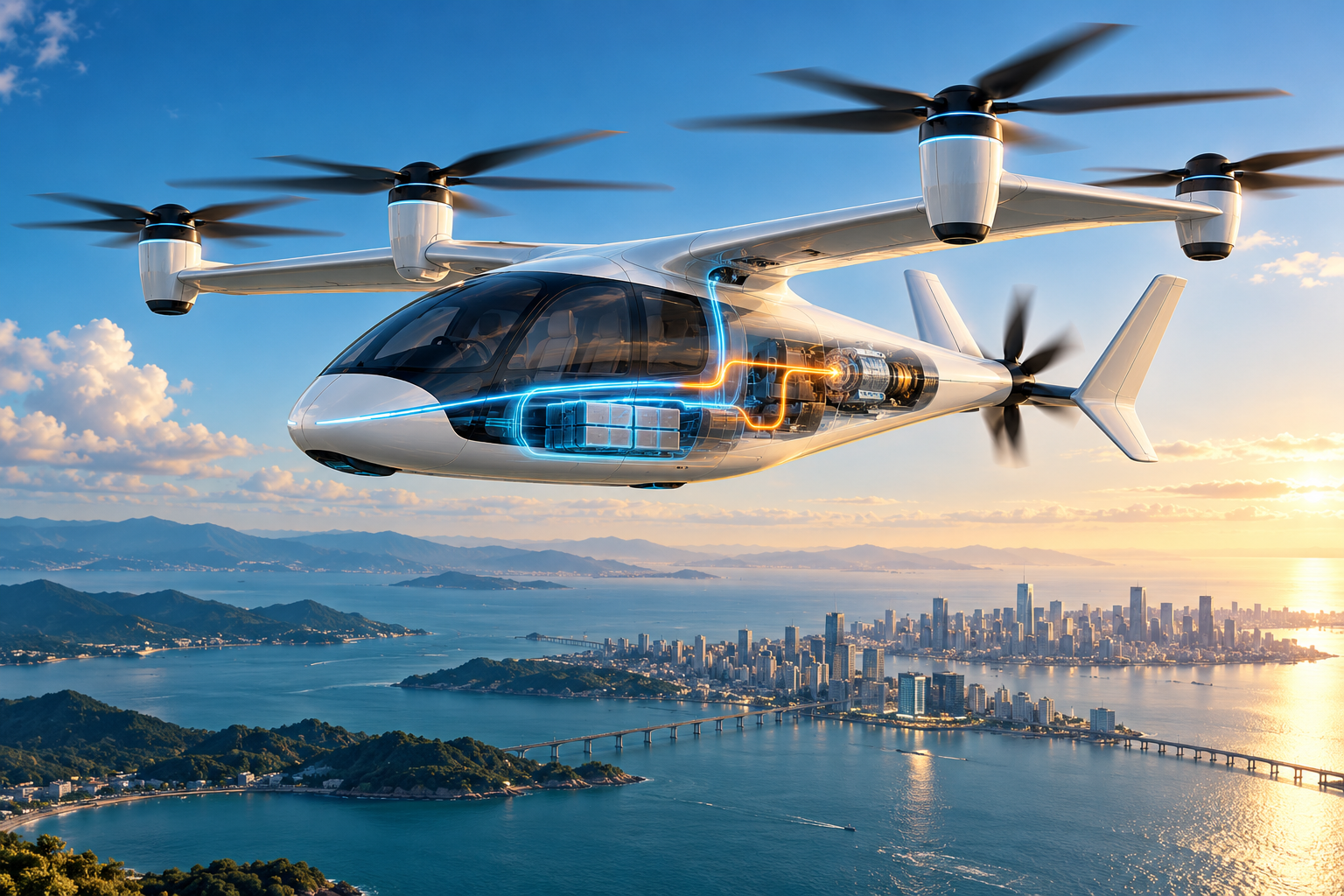
eVTOL means electric vertical takeoff and landing. Honda’s proposed system uses a gas turbine to generate electricity for electric propulsion. Its lift-and-cruise design combines vertical lift rotors with fixed wings for forward flight. The word electric describes part of the propulsion system; hybrid means this is not simply a battery-only aircraft.
Honda’s official project overview describes intercity passenger transport as the intended use. It lists a target range of 400 km, including an instrument-flight reserve assumption, and capacity for four or more passengers with one onboard pilot. Those figures are development targets rather than a certified airline timetable.
What happened in Honda’s first full-scale flight?
In an update published on May 12, 2026, Honda reported that a full-scale demonstrator completed its first flight on April 1 in San Luis Obispo County, California. The company said the aircraft weighed approximately 7,000 pounds and flew for about 90 seconds. Honda also described earlier testing with subscale models.
The useful milestone is scale: the team can now examine the behaviour of a much larger demonstrator. The announcement does not establish that the aircraft has demonstrated its proposed intercity range, entered production or started carrying fare-paying passengers.
Why combine a turbine with electric motors?
Think of the system as an energy chain: fuel powers a turbine, the turbine drives a generator, and electricity powers the motors. Honda presents this architecture as its approach to range and operational performance.
From an engineering perspective, the comparison should cover the whole journey. Ask how much energy the aircraft needs for takeoff, cruise, landing and reserves. Then ask what the complete power system weighs and how it will be maintained. The presence of electric motors alone does not answer those questions.
Is an eVTOL the same as a flying car?
No. An air-taxi aircraft does not need to drive on roads. Its journey depends on suitable takeoff and landing locations and the connections between those locations and the passenger’s destination.
The FAA’s advanced air mobility FAQ describes potential passenger, cargo and emergency-response uses, and explains the role of vertiports, airports and other secure landing areas. The agency also stresses aviation safety expectations for passenger operations. These are broader operational questions than whether a vehicle can lift off.
For the road-vehicle side of the story, see our Tesla flying car and Roadster fact-check.
When could passengers use Honda’s hybrid eVTOL?
Honda says it is working toward FAA type certification in the 2030s. That is an objective, not a guaranteed launch date. Its project page describes technology validation as ongoing and says the production configuration will develop further.
It helps to track three separate milestones: demonstrated technical capability, approval for the intended aircraft and operation, and a service customers can actually use. Progress at one stage should not be reported as completion of all three.
What would make an air taxi useful?
Our assessment is that travellers will judge the complete trip. A fast flight has less practical value if reaching the landing site, waiting and arranging onward transport consume the time saved. Useful questions include:
- How convenient are the departure and arrival locations?
- What happens when weather disrupts a flight?
- What is the total passenger price?
- How frequent and reliable is the service?
- How will surrounding communities experience the operation?
These are evaluation questions, not claims that Honda has already solved or failed them.
Frequently asked questions
Is Honda’s hybrid eVTOL fully battery powered?
No. The announced concept combines a gas turbine generation system with electric propulsion.
Has Honda launched a public air-taxi service?
The announcements linked here describe research, flight testing and future certification goals. They do not announce a bookable public service.
Does the first flight prove the 400 km range?
No. The first-flight announcement and the published range target describe different things.
Follow TheTechSky’s Technology coverage for updates that separate measured results from future ambitions. Have a question about emerging transport? Send it to TheTechSky for a future explainer.
Leave a Reply