NASA has opened a competition that could help turn mid-power Hall effect thrusters from promising designs into tested prototypes. The Advanced Mid-Power Electric Rocket (AMPERE) Challenge offers up to $500,000 in total awards for two U.S. teams. It is a development challenge, not an announcement that a new engine is ready to fly.
NASA announced AMPERE on November 18, 2026. Registration is open to U.S. companies through January 27, 2027. The agency plans a three-stage process: teams submit designs and plans, selected teams build prototypes with NASA support, and prototypes are tested at NASA’s Glenn Research Center. Here is what the challenge is trying to solve and why this type of propulsion matters.
What is a Hall effect thruster?
A Hall effect thruster is an electric engine used in space. It feeds a propellant gas into a channel, ionizes the gas, then uses electric and magnetic fields to accelerate charged particles out the back. That exhaust produces thrust. NASA describes Hall thrusters as part of solar electric propulsion systems, where electricity—often from solar arrays—powers the engine.
The trade-off is easy to miss in dramatic illustrations: electric engines provide gentle acceleration rather than the powerful, brief push of a chemical rocket. A spacecraft can keep accelerating over long periods, so this approach can use far less propellant for suitable missions. NASA says solar electric propulsion systems can use about one-tenth the propellant of comparable chemical systems, but that is a broad system-level comparison—not a performance figure promised for AMPERE prototypes.
Less propellant can mean less mass devoted to fuel and more flexibility for a mission. But electric propulsion still needs a substantial source of electrical power, and its low thrust makes it unsuitable for every maneuver. It does not replace a launch rocket that must lift a spacecraft from Earth.
What NASA’s AMPERE challenge will test
AMPERE targets the mid-power class of Hall thrusters. NASA has not described the challenge as a single finished engine design. Instead, it is inviting companies to propose a thruster design, explain how they would manufacture it, and submit cost and performance projections in Phase 1. NASA may select two teams to move on.
In Phase 2, selected teams would develop prototypes and collaborate with NASA personnel. NASA says winning teams may get early, no-cost access to agency-developed Hall-thruster technology that uses krypton propellant, through licensing. Phase 3 would put prototypes through tests at NASA Glenn, also at no cost to participating teams. NASA says two winners may each receive up to $250,000, making the total award pool up to $500,000.
NASA says the challenge is meant to lower barriers to development by pairing companies with technical expertise and test facilities. The agency has not yet named winners or reported results from AMPERE hardware. Those milestones will come only after teams register, are selected, build prototypes and complete testing.
Why mid-power electric propulsion matters
Satellites already use electric propulsion for tasks such as changing or maintaining an orbit. More capable systems could give future spacecraft additional options for long-duration trips, cargo movement and commercial operations in space. The benefit depends on the mission: continuous, efficient thrust can be valuable when there is time to build speed gradually, while a chemical engine remains better for high-thrust burns.
AMPERE is also a technology-maturation effort. A successful laboratory prototype would be evidence that a design can progress through development and ground testing. It would not by itself prove the system is flight-qualified, suitable for a crewed mission, or ready for a specific NASA spacecraft. Space hardware still has to meet demanding requirements for power, lifetime, reliability and operation in its intended environment.
For readers interested in other emerging propulsion ideas, our Honda hybrid eVTOL explainer covers an aircraft concept that operates in Earth’s atmosphere. An electric space thruster solves a very different problem and should not be confused with a flying car engine.
What happens next?
Companies interested in the challenge can review NASA’s official AMPERE rules and eligibility details. NASA lists January 27, 2027, at 5 p.m. Eastern Time as the registration deadline. The agency also held a virtual industry day on November 19, 2026, to introduce the opportunity.
Frequently asked questions
Is NASA building a new rocket engine?
NASA is inviting U.S. companies to develop and test Hall effect thruster prototypes through a competition. The announcement does not say that a new flight-ready engine has been completed.
Can an electric thruster launch a spacecraft from Earth?
No. Hall effect thrusters provide low, steady thrust for use in space. A chemical launch vehicle is needed to lift a spacecraft from Earth’s surface and place it in orbit.
How much funding is available?
NASA says two winning teams may be selected to receive up to $250,000 each. The maximum combined award is therefore $500,000, alongside access to NASA expertise and test facilities described in the challenge.
Sources
- NASA: AMPERE Challenge announcement
- NASA: Solar Electric Propulsion overview
- Official AMPERE challenge rules and registration
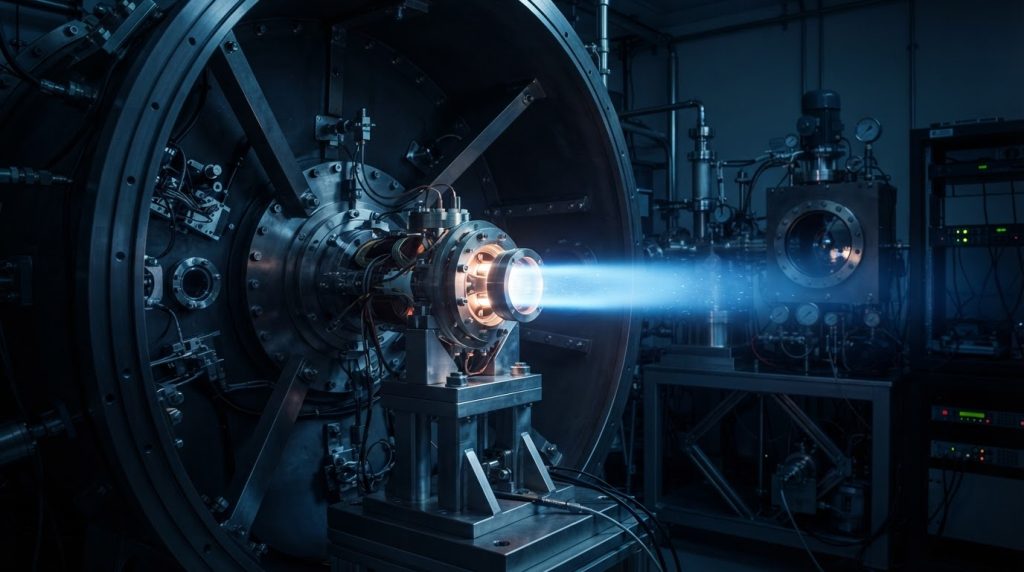
Editor’s note: The illustration above is AI-generated and represents the technology generally; it does not depict NASA equipment or a particular prototype.
Leave a Reply