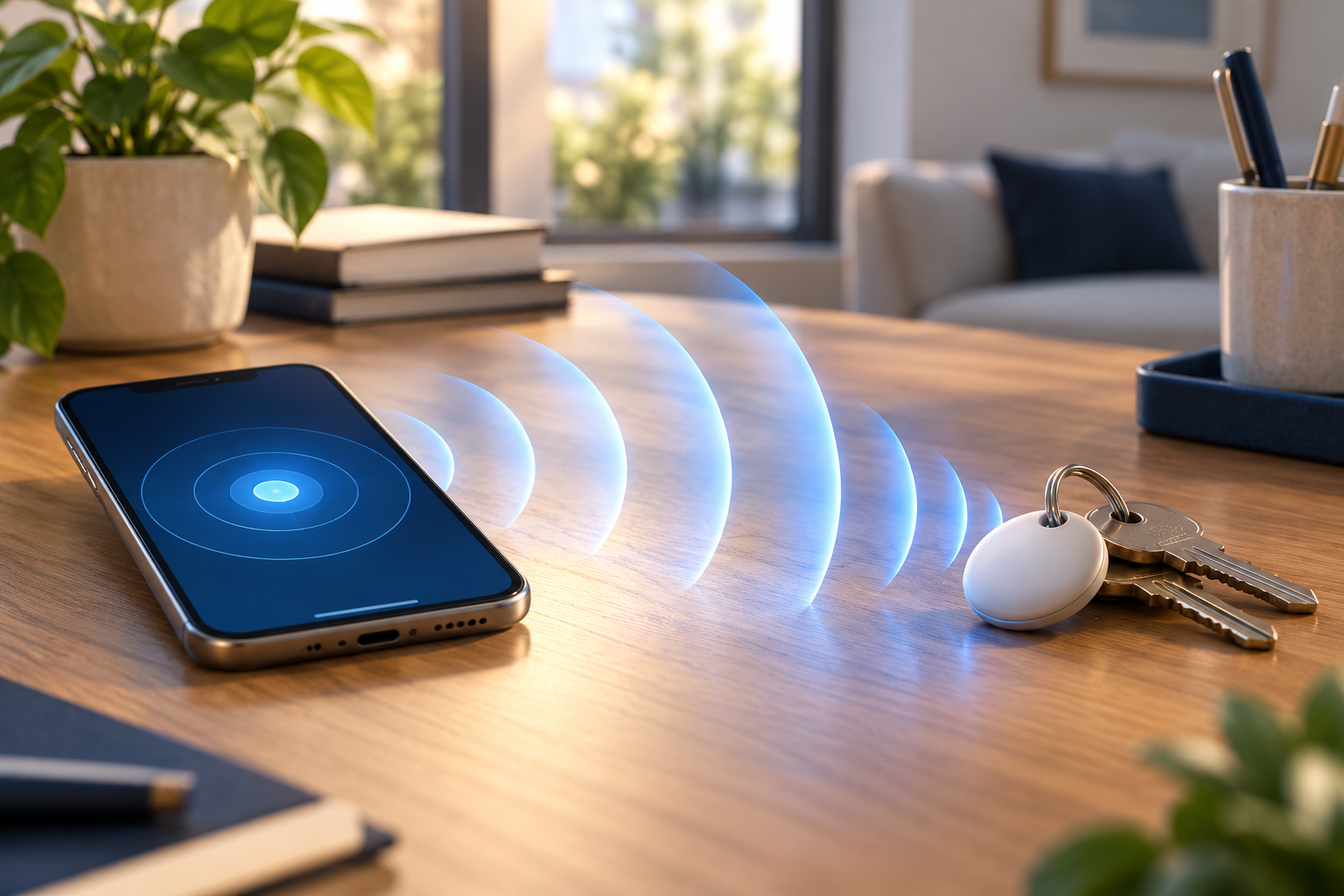
Bluetooth Channel Sounding helps compatible connected devices estimate how far apart they are. For users, the interesting possibility is more useful nearby-device finding: knowing that an item is connected is different from knowing whether it is close enough to reach.
The feature is part of Bluetooth Core 6.0, but a Bluetooth version number alone is not enough to establish that a particular phone-and-accessory combination supports it. Here is what the technology does, where its limits are, and what to check before choosing a product. Sources checked October 22, 2026; this is an explainer, not a hands-on product test.
What is Bluetooth Channel Sounding?
The Bluetooth SIG’s feature overview describes Channel Sounding as a way to add fine distance awareness to Bluetooth connections. Potential applications include locating personal items and deciding when an authorised device is close enough for a digital-key interaction.
The useful distinction is between detecting a device and estimating its distance. A connection answers one question; a distance estimate can help an application answer another. Neither automatically tells you which drawer an object is inside.
How does it measure distance?
Two techniques underpin the feature. Phase-based ranging compares radio signals across frequencies. Round-trip timing uses the time taken by exchanged packets to provide another measurement. The Bluetooth Low Energy primer explains the protocol and device roles in more detail.
Think of the distinction this way: a signal-strength indicator asks how strongly a transmission arrived, while ranging examines properties of the exchanged signals to estimate separation. These are different inputs to a device-finding experience.
Channel Sounding should also be understood as part of a system. The radio measurements, the algorithm that interprets them and the app that presents the result all matter. An impressive specification cannot substitute for evaluating the finished product.
Does it make every tracker accurate to the centimetre?
No. The Bluetooth SIG describes centimetre-level ambitions, but that phrase should not be read as a universal promise of one-centimetre precision. Its FAQ discusses results in terms of tens of centimetres and explains that implementation and operating conditions matter. It also says the standard does not prescribe a single distance-calculation algorithm.
For a buyer, the practical question is whether a supported product finds an item reliably in the places where it will be used. A numerical distance display that fluctuates heavily may be less helpful than a simpler, stable indication that you are getting closer.
Will my existing phone and accessories support it?
Check the exact products rather than assuming a software update will add the feature. The Bluetooth SIG says upgrade possibilities depend on the manufacturer and may require different Bluetooth hardware.
As one concrete example, Apple’s developer documentation exposes a capability check for Bluetooth Channel Sounding and tells developers to check it before starting a ranging session. Its Nearby Interaction implementation also specifies accessory-pairing requirements. That is evidence that support must be checked, not evidence that every iPhone or paired accessory supports the feature.
A practical compatibility checklist
Before paying extra for distance-aware finding, ask:
- Does the exact phone model support Channel Sounding?
- Does the exact accessory support it with that phone?
- Which operating-system version and app are required?
- Does the advertised finding experience actually use this feature?
- What do the manufacturer’s instructions say about setup and limitations?
These questions are more useful than comparing version labels in isolation. Save the product’s compatibility information so you can check the claim against the device you receive.
What this feature does not establish
A nearby-distance estimate does not, by itself, provide worldwide location tracking, a complete security guarantee or an improvement to music quality. Those are separate product capabilities that need their own evidence.
Our assessment is that distance-aware technology is most useful when the result helps someone make a simple decision: move closer, search a smaller area or confirm that the intended device is nearby. The quality of that experience depends on the complete implementation.
Frequently asked questions
Is Bluetooth Channel Sounding the same as GPS?
No. This feature concerns ranging between compatible Bluetooth devices. Do not assume it provides a geographical location or works when the relevant devices cannot communicate.
Should I replace a working tracker immediately?
Start with the problem your current tracker fails to solve. If it already helps you find your belongings reliably, a new feature name alone is not a reason to replace it. Confirm the exact compatibility and practical benefit first.
Where can I learn more about evaluating new technology?
Our Tesla Roadster fact-check and Honda hybrid eVTOL explainer apply the same principle: separate the demonstrated capability from the broader promise. For more explainers, browse TheTechSky’s Technology section or send us a question.
Leave a Reply